
Imagine this scenario: you type a brilliant, multi-layered prompt into an AI vector generator. A few seconds later, the machine spits out a flawless, minimalist emblem. It is perfectly aligned with your client’s brand ethos. You pack it up, send it over, hand over the invoice, and consider it a job well done.
But six months later, a direct competitor copies that exact logo line-for-line, changes the business name, and starts running ads. When your client tries to sue for intellectual property infringement, their legal team delivers a harsh truth: the logo has zero copyright protection.
In 2026, the intersection of generative AI and intellectual property law has solidified into a strict, high-stakes framework. While AI is an incredible tool for rapid ideation, building an entire brand identity on raw AI outputs without understanding the legal guardrails is like building a house on shifting sand.
Over at logodesigninspo.com, we want you to create bold concepts—but we also want you to protect them. Let’s break down the current legal reality of safeguarding AI-assisted logos.
1. The Crucial Split: Copyright vs. Trademark
To understand how to protect a brand asset, you must first stop grouping all intellectual property into the same bucket. The law treats copyright and trademark as completely separate legal concepts, and they behave very differently when AI enters the equation.
| Legal Pillar | What It Protects | Human Authorship Required? | AI Logo Eligibility Status |
| Copyright | Original artistic and creative expression. | Yes. Absolutely mandatory. | Ineligible if generated purely by prompts. |
| Trademark | Source identifiers (logos, names, slogans) used in commerce to prevent market confusion. | No. The method of creation is irrelevant. | Fully Eligible if it is distinctive and actively used in business. |
2. Why Pure AI Logos Cannot Be Copyrighted
The bedrock of copyright law is human creativity. In March 2026, the U.S. Supreme Court put a definitive end to this debate by refusing to hear the final appeal of Thaler v. Perlmutter, cement-locking the rule that only natural human beings can hold copyright authorship.
The U.S. Copyright Office (USCO) explicitly states that entering a text prompt into an AI model like Midjourney, DALL-E, or Recraft does not make you the “author” of the resulting image. The legal logic goes like this: you are simply giving instructions to a machine, much like a client giving a creative brief to a human designer. Because the algorithm—not the human—determines the final expressive arrangement of pixels and paths, the raw output belongs instantly to the public domain.
The Prompt Fallacy: Writing a 500-word, highly detailed prompt with negative modifiers and style references does not change this ruling. The law views text prompts as conceptual influence, not authorial execution.
3. The Protective Bridge: Moving from “Generated” to “Assisted”
Does this mean you have to abandon AI entirely if you want to create legally defensible logos? Not at all. The USCO and the European Union Intellectual Property Office (EUIPO) both recognize a clear legal boundary between purely AI-generated content and AI-assisted human content.
A logo concept born in an AI engine can qualify for copyright protection, but only if a human designer adds significant, original creative intervention after the initial generation.
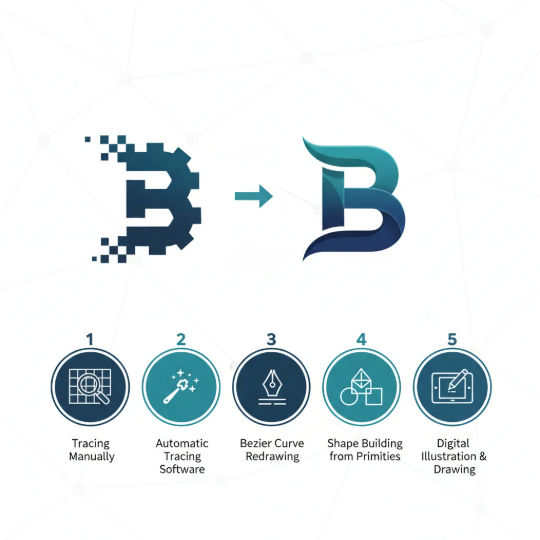
Cropping the image, slightly tweaking the color hex codes, or running a basic automated image trace is not enough. You must actively inject your own human authorship by dramatically altering, rearranging, or drawing over the AI’s baseline asset—such as integrating original geometric structures, custom hand-lettered typography, or combining multiple disparate AI assets into a wholly unique layout.
4. The Defensive Blueprint: How to Secure an AI-Assisted Brand Identity
If you use artificial intelligence during your creative discovery and design phases, you must establish a strict file-management pipeline to prove your human contribution if your ownership is ever challenged in court.
Follow this systematic operational workflow to protect your brand designs:
💡 The Takeaway for Modern Designers
If a client wants absolute, bulletproof protection for a global brand identity, the safest path remains creating original vector marks entirely from scratch.
However, if you choose to harness the unmatched speed of generative AI for ideation, always treat the AI’s output as a rough, unrefined creative sketch—never the final product. By treating the machine as a collaborative mood board and doing the heavy design lifting yourself, you ensure your client’s visual identity remains creatively brilliant, commercially distinctive, and completely defensible under the law.
Leave a Reply