
There is a distinct pleasure in discovering something hidden in plain sight.
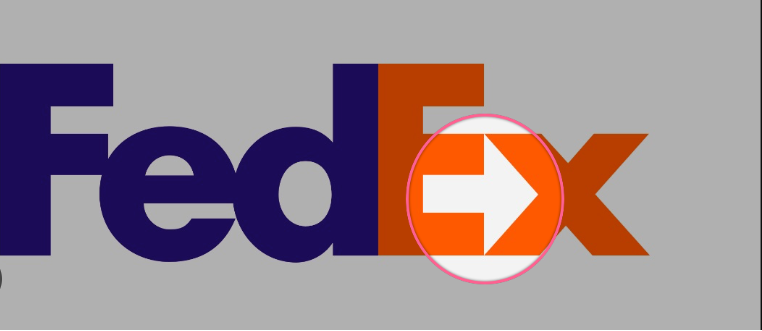
Think back to the first time someone pointed out the white arrow tucked neatly between the capital “E” and the lowercase “x” in the FedEx logo. If you are like most people, it was a genuine “aha!” moment. And once your brain maps that negative space, your visual relationship with the brand changes forever. You can never unsee it.
Designed in 1994 by Lindon Leader during his tenure at Landor Associates, the FedEx wordmark has won over 40 design awards and is consistently ranked by design purists as one of the greatest logos ever created.
For any designer looking to master the art of visual economy on logodesigninspo.com, the FedEx logo is the ultimate case study in negative space—the space around and between the subject of an image that creates an entirely new form.
The Origin Story: Sifting Through 400 Iterations
In the early 1990s, Federal Express was facing a major identity crisis. The global shipping company had expanded far beyond its original American footprint, but its name felt clunky, overly bureaucratic, and hard to translate across international markets. Crucially, customers had already taken matters into their own hands, naturally shortening the name to a snappy, two-syllable verb: “FedEx it.”
Lindon Leader was tasked with compressing the name and modernizing the corporate aesthetic. The research phase alone took months, involving global focus groups and a deep structural review of the company’s core values.
Leader didn’t set out with the explicit goal of hiding an arrow. Instead, he was hunting for a typographic solution that conveyed speed, precision, and reliability without relying on cheesy, literal illustrations of delivery trucks or airplanes.
After generating more than 400 design concepts, Leader noticed something interesting while experimenting with two specific typefaces: Univers 67 and Futura Bold. When placed side-by-side, the unique geometry of the uppercase “E” and the lowercase “x” naturally suggested the faint outline of a wedge.
The Forensic Typography: Forging the Illusion
Creating the FedEx arrow wasn’t as simple as typing out the letters and adjusting the tracking. It required a surgical level of font customization.
Standard letterforms are not designed to lock together like puzzle pieces. To make the negative space arrow perfectly crisp and mathematically sound, Leader had to completely reconstruct the characters:
-
The top and bottom bars of the “E” were extended.
-
The internal counter spaces (the negative spaces inside the letters) were altered.
-
The slant and terminal angles of the “x” were customized to align flawlessly with the central bar of the “E”.
[Custom "E"] + [Tailored "x"] = Perfectly Defined White Arrow
Had the design team left the letterforms in their stock configuration, the arrow would have looked distorted, clumsy, or accidental. The genius of the execution lies in its absolute restraint; the arrow is structurally invisible until your mind decides to actively decode the white canvas.
The Strategic Psychology of Subconscious Marketing
Why does this subtle design approach work so much better than a giant, literal arrow slapped onto the side of a delivery box? The answer lies in consumer psychology and the concept of subconscious reward.
| Brand Communication Metric | Literal Logo Strategy | Negative Space Strategy (FedEx) |
| Cognitive Friction | Zero; tells the viewer exactly what to think immediately | Low-to-medium; invites the viewer’s brain to solve a puzzle |
| Visual Longevity | Risks aging quickly as literal design trends shift | Highly future-proof; relies on timeless geometric interaction |
| Brand Recall | Linear and transactional | High; driven by the emotional dopamine hit of discovery |
| Slogan Alignment | Requires text to explain corporate values | Subconsciously mirrors values (Forward motion, accuracy) |
When a brand screams its message directly at the consumer, the human brain treats it as standard advertising noise and filters it out. But when a brand allows the consumer to discover a hidden symbol on their own, it activates a micro-moment of intellectual satisfaction. That positive emotional association embeds the brand much deeper into the user’s long-term memory.
Furthermore, the arrow perfectly communicates the company’s functional promise: moving a package from point A to point B cleanly, quickly, and without error.
Key Takeaways for Modern Identity Designers
The FedEx case study offers timeless rules for building impactful modern brand identities:
📌 The Lindon Leader Design Blueprint
1. Less is Always More: A great logo should strive for minimalism. Lindon Leader’s personal design philosophy is anchored in two words: simplicity and clarity. If you can make one element do two jobs simultaneously (acting as a letter and a directional symbol), you have achieved peak design efficiency.
2. Don’t Overlook the Canvas: Most amateur designers focus 100% of their energy on the positive shapes—the lines, the vectors, and the fills. True pros look just as closely at the empty white space surrounding those shapes. The background is not passive; it is a live design asset.
3. Fight for Your Concepts: When Landor Associates presented the final logo to the executive board at Federal Express, almost none of the senior leadership noticed the arrow right away. It took Fred Smith, the CEO of the company, pointing it out to unlock the room’s approval. As a designer, you must learn to articulate the hidden intelligence of your work to clients who might only scan the surface.
Ultimately, the FedEx wordmark reminds us that graphic design at its highest tier is not about decoration. It is about communication, architecture, and behavioral psychology disguised as simple typography.



Leave a Reply