
In the history of graphic design and corporate marketing, certain brand assets achieve a mythic status. Nike has the Swoosh, Apple has its bitten apple, and until recently, Twitter had the blue bird. Named “Larry,” the minimalist blue bird icon was more than a logo; it was a global cultural anchor. It spawned its own vocabulary—tweeting, retweeting, tweetstorms—and became one of the few brand assets in human history to transform into a universally understood verb.
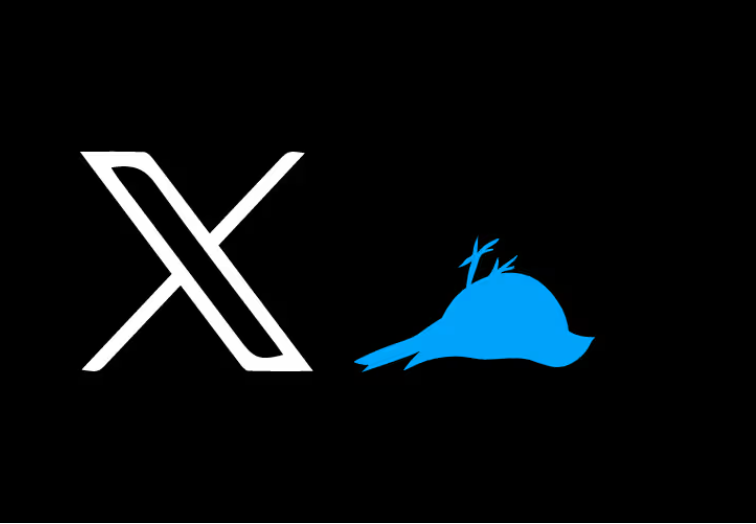
Then, in July 2023, Elon Musk did the unthinkable. With a single series of late-night posts, he executed a scorched-earth rebrand, erasing the beloved blue bird overnight and replacing it with a stark, monochromatic “X”.
Looking back at this historic pivot, the transformation remains the most polarizing, radical case study in modern branding. How do you move past a multi-billion-dollar logo, and what happens to a brand when you do? Let’s dive in.
The Architecture of an Icon: What Made Larry Great
To understand the sheer magnitude of the risk, we must first look at what made the 2012 Twitter logo a masterpiece of modern design. Designed by Martin Grasser, the final iteration of the Twitter bird was crafted using nothing but three sets of overlapping circles.
[Geometric Harmony] + [Perfect Balance] = Instant Recognition
The logo relied entirely on the mathematical perfection of the Golden Ratio. Its beak and wings angled upward to symbolize hope, freedom, and high-velocity communication. It was clean, highly scalable, and functioned perfectly as a smartphone app icon or a tiny social media sharing widget on an external news site.
More importantly, it possessed immense brand equity. Financial analysts estimated that the Twitter name and bird icon accounted for anywhere between $4 billion and $5 billion of the company’s intrinsic value. It was a visual shorthand for global conversation.
The Anatomy of the “X”: Anti-Design or Radical Futurism?
When the rebrand dropped, the design community watched in collective horror as the harmonized, custom-crafted bird was swapped for a logo that wasn’t even custom-made.
The primary “X” logo is a slightly modified version of a standard Unicode glyph known as “Mathematical Double-Struck Capital X” ($\mathbb{X}$).
The Aesthetic Shift
-
The Bird: Soft curves, friendly sky-blue palette, approachable, community-centric.
-
The X: Sharp angles, harsh pitch-black slate, aggressive, individualistic, brutalist.
Musk’s vision, however, was never to maintain a social media platform. The rebrand was a structural announcement of a pivot toward an “Everything App”—modeled after platforms like WeChat in China, combining microblogging, multimedia creation, peer-to-peer banking, and AI integration. From a strategic standpoint, a friendly blue bird simply could not carry the weight of a financial institution or a futuristic tech conglomerate. The “X” was chosen to represent the unknown variable, the crossroads of data, and the future.
The Playbook Breakdown: Traditional vs. Radical Rebranding
Traditional branding agencies spend months, sometimes years, testing consumer sentiment, refining line weights, and planning gradual rollouts. The Twitter-to-X transition threw that entire playbook out the window.
| Rebranding Metric | Traditional Strategy (The Bird) | The X Strategy |
| Transition Window | 6 to 18 months of quiet, internal testing | Less than 24 hours from announcement to live app update |
| Visual Development | Custom geometry, extensive copyrighting | Open-sourced crowd sourcing, standardized Unicode origin |
| Community Alignment | Focus on user comfort and legacy trust | Top-down disruption, intentional shock value |
| Color Psychology | Trust, security, openness (Sky Blue) | Power, premium authority, mystery (Black/White) |
The Long-Term Fallout: What Designers Can Learn
Shifting a logo instantly is easy; shifting human habit is an entirely different battle. The rebrand faced a massive psychological hurdle: the vocabulary lag. For a long time, mainstream news outlets and everyday users continued to write: “Posted on X (formerly known as Twitter).”
Why? Because “Xing” a post doesn’t roll off the tongue quite like “tweeting.” This case study proves a vital law of graphic design: Verbs are significantly harder to replace than vectors.
📌 Key Takeaways for Designers & Modern Brands
1. Subtraction is a Double-Edged Sword: Minimalist geometry is powerful, but when a logo becomes too abstract (like a generic letter of the alphabet), it risks losing its proprietary trademark power and distinct emotional resonance.
2. Align the Visuals with the Ecosystem: If you are changing a company’s fundamental business model, a radical rebrand is justified. The “X” successfully detached the company from its old identity, signaling to investors that the legacy social network was dead, and a new tech laboratory had taken its place.
3. Brand Equity Requires Cultivation: Erasing an iconic logo means resetting your relationship with the consumer back to zero. Unless you possess the unmatched cultural gravity or the astronomical budget of an entity like Elon Musk, discarding a globally recognized asset overnight can be fatal for a standard business.
Ultimately, the Twitter to X rebrand will go down in design textbooks as the ultimate battle between legacy brand equity and radical executive ideology. It stands as a monument to the fact that a logo is never just a drawing on a screen—it is a living, breathing contract of trust between a platform and the global public.
Leave a Reply